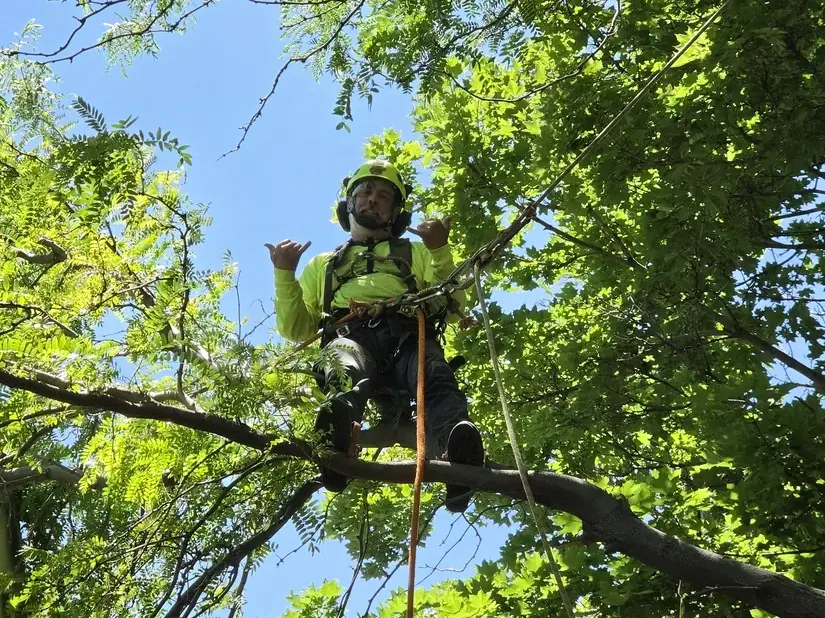
By Mikey Wilson, ISA Certified Arborist (#UT-4612A), 15+ years as an arborist · Published October 28, 2026 · 7 min read
"Arborist" is a job title anyone in Utah can use. A Certified Arborist has earned the International Society of Arboriculture (ISA) credential: years of tree-care experience, a 200-question exam, and continuing education to keep it. If you want one to look at a tree before anyone cuts, that's a Certified Arborist Tree Inspection.
What an Arborist Is vs. What a Certified Arborist Is
Utah has no state program for testing or licensing arborists, according to Red Butte Garden, so the word on a truck door is a description, not a credential. And a company that says it's "licensed" in Utah most likely means a plain business license. That tells you the business is registered. It doesn't tell you anyone can read a tree.
ISA certification is voluntary, which is part of why it means something. To sit for the exam you need at least three years of full-time experience in arboriculture, or a mix of education and experience. A four-year degree with arboriculture courses, for example, cuts the experience requirement to one year. Then comes a 200-question multiple-choice exam across ten areas, including:
- Tree biology, meaning how roots, trunk, branches and leaves work.
- Pruning.
- Diagnosis and treatment of tree problems.
- Tree risk, so you can tell when a limb or a whole tree is likely to fail.
- Soil management, trees and construction, and safe work practices.
Passing once isn't the end of it. Every three years a Certified Arborist has to earn 30 continuing education units or pass the exam again. ISA also runs an online certificate lookup, but the simplest check is the one I'd make with any contractor: ask to see the certification and the number.

I'm an ISA Certified Arborist (#UT-4612A) and I've worked as an arborist for more than 15 years. The habit that matters most is simple: I diagnose a tree before I decide to cut it. That includes working out whether the tree is in a good window for pruning, given its species and what it needs.
Here's what the difference looks like in a yard. Topping, which means cutting a tree's main branches back to stubs, is the clearest example. The ISA calls it "perhaps the most harmful tree pruning practice known." The tree answers by throwing up a flush of fast shoots below every cut. In the field we call those suckers, and the textbook name is epicormic growth. Unlike normal branches, the shoots are anchored only in the outer layers of the old branch, so they snap easily in wind and ice. The stubs underneath are open wounds that the tree often can't seal, and decay moves in.
I was called to West Valley City to look at an elm that had been topped about a year earlier. The owner told me the new growth had shot up fast, but it looked thin and weak. The suckers had joined the old stems at weak unions, which makes them much more likely to fail. I recommended removing the tree, and it came down safely.
Whoever topped that elm may have been honest and may have had years on a saw. Years of cutting isn't the same as knowing why a tree reacts the way it does, and the title on the truck can't tell you which kind of crew you've got. The questions they ask can.
Tell me about your tree. Get Free Estimate or Call (801) 809-2611, Monday to Friday, 9 AM to 5 PM.
Tree Trimmer vs. Arborist: Where the Lines Blur
Tree trimmers and arborists often do the same physical work. They climb, they cut limbs, and they haul brush to the chipper. From the street, a good trim and a bad one can look almost identical for the first year or two. The difference shows up later.
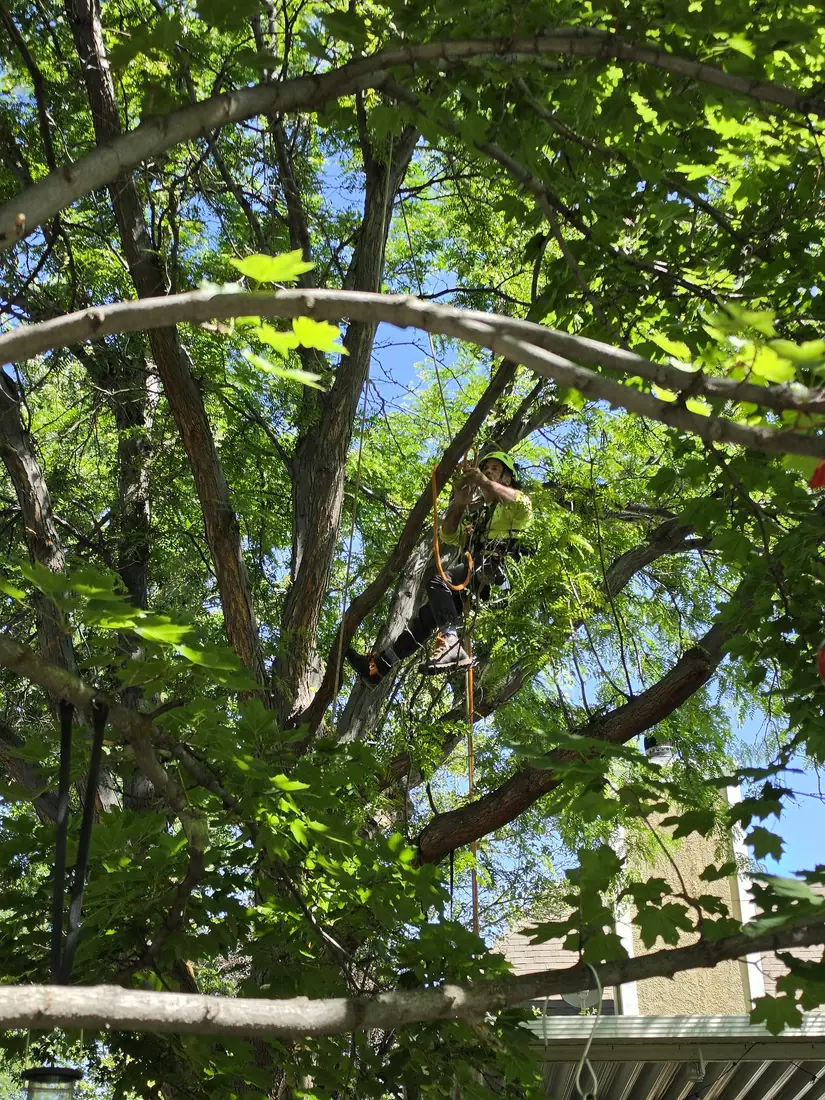
A trimmer typically focuses on how the tree looks right now. "How much do you want off?" "Where's it hitting the roof?" An arborist asks different questions. Why is this limb growing that way? Is the wood sound? How will this cut heal? Certification doesn't guarantee that thinking, but it's the closest thing to proof that someone has been trained to do it.
Look for these signs during the estimate:
- They offer to top or "round over" a big shade tree just to make it shorter.
- Nobody checks the trunk, roots or soil before giving you a quote.
- They plan to strip the inner branches and leave foliage only at the tips.
- They climb with spikes to prune a tree. I don't climb with spikes on a prune.
- They can't produce a certification number when you ask for one.
None of these proves bad intent. But they're the habits that hurt trees, and they tend to show up together.
To be fair, a trimmer is fine for simple jobs: a hedge along a fence line, or a few small limbs off the garage. The stakes climb with mature trees. The old elms in the Avenues took decades to grow, and one wrong cut can undo a lot of that.
That's why the answer isn't always a cut. After a diagnosis it might be thinning the crown, cabling and bracing, or waiting for the right pruning window. Sometimes it's doing nothing this year.
See how that plays out in our tree trimming and pruning work, or start with our arborist services.
Which Tree Jobs Need a Certified Arborist
Not every tree job needs a Certified Arborist. Some do. The dividing line is judgment: a skilled crew can handle the cutting, but deciding what to cut, why, and what the tree will do afterward is where the training pays off.

In Salt Lake City proper, one category isn't a judgment call at all. Salt Lake City Urban Forestry requires a permit to remove, prune or plant any tree in the public right-of-way, and permits are only issued to ISA-certified arborists. A tree in the park strip, between the sidewalk and the street, may be in the right-of-way. Most homeowners figure the city owns those trees but assume they don't need a permit to work on one, and if the tree is in the right-of-way, they do. If you're not sure, Urban Forestry can confirm at (801) 972-7818.
Beyond park strips, these are the jobs where I'd tell any friend to insist on a Certified Arborist:
- Tree risk assessment on a big tree, especially one near your house, garage or driveway. I hold the ISA's Tree Risk Assessment Qualification (TRAQ) for this.
- Diagnosis when leaves yellow early, bark splits, or branches die back for no clear reason.
- Cabling and bracing for a split trunk or a weak branch union.
- Crown reduction on a mature tree, because bad cuts there invite decay.
- Tree appraisals, for insurance claims, property disputes or construction damage.
- Tree preservation planning before anyone digs, pours concrete or builds near the roots.
See the common thread? Every one starts with a diagnosis. You're paying someone to understand the tree before anyone picks up a saw.
Utah's soil adds its own wrinkle. Alkaline soils are common here, and in them a tree can't take up iron, so some species, including silver maples and pin oaks, turn pale yellow. That can look like disease or bugs, and it's easy to spend money on the wrong fix. A diagnosis tells you which one you're dealing with first. I wrote up one case, a Sugar House Norway maple another company had called a goner, in What Is an Arborist Consultation?
So what doesn't need a Certified Arborist? Plenty. Hedge trimming. Stump grinding. Hauling away a fallen branch after a windstorm. Taking down a small dead tree out in the open with nothing nearby to hit. For those jobs you need a careful, insured crew with good equipment.
Here's a simple test. Does the job have a right answer that someone has to figure out first? If so, call a Certified Arborist. If the answer is already obvious, like grinding a stump you know you want gone, you're mostly paying for labor.
The value of certification isn't the badge on the truck. It's having someone who will tell you when you don't need the big, expensive job, and when you do. A hazardous tree leaning over a bedroom is a different conversation.
Tell me about your tree. Get Free Estimate or Call (801) 809-2611, Monday to Friday, 9 AM to 5 PM.
Arborist vs. Certified Arborist: What's the Difference?
Prefer to watch? Open the video on YouTube.